Date: February 2, 2026
Author: Dr. LIU Guohong, President of CDI
Editor’s Note: On January 25, 2026, Dr. Liu Guohong, President of CDI, delivered a speech titled “Trends and Outlook for Private Enterprises during the 15th Five-Year Plan (FYP) Period” at the Forging New Resilience for Private Enterprises Summit. In his speech, Dr. Liu reviewed the 40-plus-year development of the private economy, highlighting three distinct growth peaks: 1984, 1992, and 2007. Each peak was driven by institutional deregulation and market opening—from the introduction of the commodity economy and the establishment of the socialist market economy system, to joining the WTO and integrating into the global economy. The next growth peak that all sectors have been calling for is likely to emerge during the 15th FYP period.
The Three Historic Growth Peaks
The first peak occurred around 1984. The term “commodity economy” appeared for the first time in central government documents, at a time when references to a “market economy” were still taboo. As constraints loosened, individual businesses, family workshops, and township enterprises sprang up like mushrooms, and China’s private economy began to take shape.
The second peak arrived in 1992. Following Deng Xiaoping’s southern tour talks, the framework for a socialist market economy with Chinese characteristics was finalized. With a clear direction established, many elites within the public system left their posts to venture into entrepreneurship. Cities like Shenzhen took the lead in clarifying the property rights of private technology enterprises to attract and empower entrepreneurs.
The third peak came in 2007 with a driving force originating from China’s accession to the WTO in 2001. During this period, Chinese private enterprises including Huawei grew stronger and bigger, and began to go global.
After these three peaks, the private economy entered a long plateau. All sectors have since been calling for the next growth wave, whether driven by institutional reform or technology breakthrough.
Five Takeaways for Private Enterprises to Navigate the 15th FYP Period
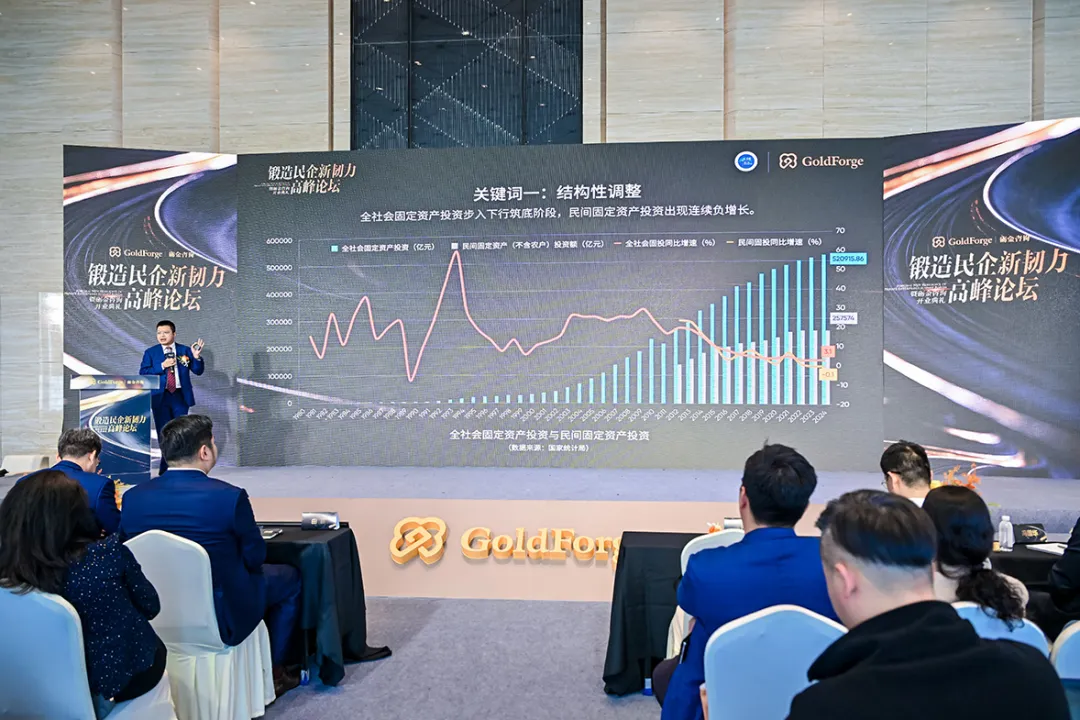
First, K-shaped growth requires major adjustments. The growth rate of national fixed-asset investment turned negative in 2025, falling by 3.8%, while private investment growth has been negative for three consecutive years. Consequently, future growth will become K-shaped. The downward stroke represents traditional industries like real estate and finance, which are massive in scale but under continuous pressure. The upward stroke represents new growth drivers, such as emerging industries, new business forms, and new business models. However, these new drivers currently account for less than 20% of GDP—promising, but still small.
According to economist Carlota Perez’s theory, as financial capital pours into technological innovations like AI, a bubble is inevitable. The bubble itself is not the problem; rather, the key question is whether financial capital and industrial capital can tightly couple again. This requires institutional change on the state’s side and active adaptation on the private side. The 15th FYP—covering the next five years—is precisely the critical window for this breakthrough.
Second, private enterprises must pivot toward niche markets. Gause’s competitive exclusion principle in biology reveals that two completely overlapping species cannot coexist for long in the same ecological niche; eventually, one will be eliminated. As the Producer Price Index continues to decline, the model of competing solely on price has become unsustainable. Future competition is about seizing a unique and favorable ecological niche. Over the next five years, mergers and acquisitions will become more prevalent—a necessary step for enterprises to reposition themselves and avoid homogeneity.
Third, global operations are becoming a necessity for survival. The pressure to “go global or get out” has caused many enterprises to act hastily in their overseas ventures, only to fail at localization. Huawei’s globalization path provides a valuable example. Its success was not achieved overnight, but through a gradual, three-step approach: testing the waters with trade, acquiring local resources, and finally exporting technological knowledge and co-building ecosystems. Additionally, a strong domestic market serves as the ballast for expanding global operations. Without domestic market support, enterprises cannot withstand the storms of overseas markets.
Fourth, corporate governance refinement is now a requirement. Township enterprises were once predicted to become the third pole of China’s economy, but that prediction never materialized. One of the core issues was a deficiency in property rights and governance. Today, a tide of change is underway; the new Company Law added “improving the modern enterprise system” to its mandate. In a highly uncertain environment, any weakness in governance can evolve into a disruptive risk. Establishing clear property rights and a modern enterprise system is a rigid necessity for private enterprises to achieve stable, long-term development.
Fifth, the private sector needs antifragile development. As outlined in Nassim Nicholas Taleb’s concept of antifragility, the wind extinguishes a candle but makes a fire burn brighter. This is particularly true for the private sector in the face of “black swan” and “gray rhino” events. Common development models tend to be extreme and inadvisable—either the passive growth of holding onto mediocre assets, or aggressive measures like going all-in on unproven technology fields. The correct strategy is to apply the barbell principle: invest the vast majority of resources in core, safe businesses that generate stable cash flow, while simultaneously using a small portion to invest keenly and boldly in high-growth areas.
Conclusion: From Insight to Action
History shows that the private economy erupts when institutions and markets find synergy. As the 15th FYP kicks off, private enterprises need to break away from path dependence and anchor themselves in new ecological niches during these structural adjustments. Only by building a solid foundation through globalization and modern governance, can they construct their own antifragile capabilities.