Overview
At present, the global geopolitical and economic landscape is undergoing profound adjustments. Unilateralism and trade protectionism are on the rise, and cross-border financial risks have increased significantly. The member states of the Shanghai Cooperation Organization (SCO) are confronted with challenges such as a large infrastructure financing gap, heavy reliance on traditional payment systems, and inadequate regional financing mechanisms.
The 2025 SCO Summit in Tianjin reached an important political consensus on the establishment of the SCO Development Bank, marking a critical step in transitioning SCO financial cooperation from a loose interbank coordination model toward a substantive operational mechanism.
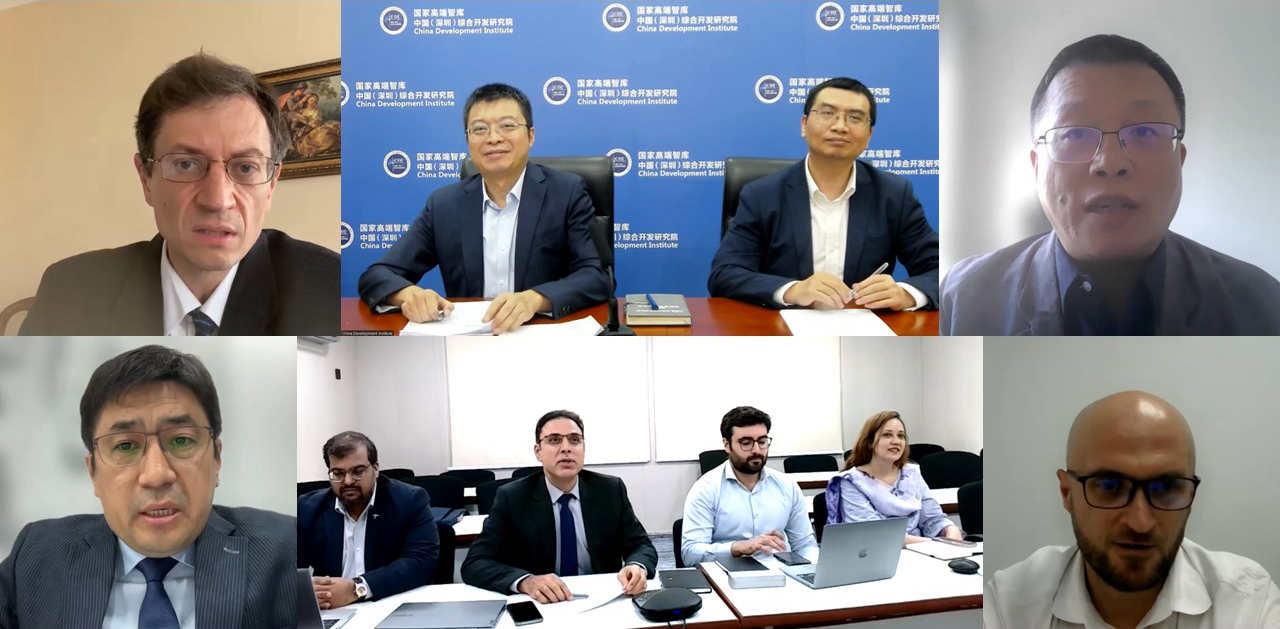
On July 29, 2026, China Development Institute (CDI) hosted the SCO Think Tank Webinar, bringing together think tank and policy experts from SCO member states to conduct in-depth discussions on key topics such as financial rule alignment, the mechanism design of the development bank, and the prospects for regional financial cooperation, in order to provide intellectual support for deepening SCO financial cooperation and advancing the development bank from an initiative into reality.
Debates
1. What opportunities, challenges, and feasible pathways exist for aligning financial rules among SCO member states?
2. How should the establishment of SCO development bank draw on the experiences of institutions like the AIIB and the BRICS New Development Bank to better provide autonomous financing tools for major regional infrastructure construction, energy projects, and the development of small and medium-sized enterprises?
3. How can a convenient, low-cost, and highly secure regional local currency settlement network be constructed to gradually reduce dependence on external currencies such as the US dollar, thereby enhancing the resilience of regional financial and trade cooperation?
Organizer: CDI
Date and Time: 29 Jul 2026 15:00-17:00 Beijing Time (GMT+8)
Keynote Speech 15:00-16:40 (Beijing Time)
Moderator: Liu Guohong, President of China Development Institute
Li Lifan, Director of the Center for SCO Studies at Shanghai Academy of Social Sciences
Yaroslav Lissovolik, Founder of BRICS+ Analytics, Former Chief Economist at the Eurasian Development Bank
Alimshan Faizulayev, Director of the PhD Program, Director of the ESG Center, Research Director of Bang College of Business, KIMEP University, Kazakhstan
Shairbek Juraev, Former Deputy Director of the OSCE Academy, Co-Founder and Executive Director of Crossroads Central Asia, Kyrgyzstan
Syed Hasanat, Executive Director, Centre of Excellence, CEPC, Pakistan Institute of Development Economics, Former Economic Analyst at the State Bank of Pakistan
Yu Lingqu, Executive Director, Financial Development Department, China Development Institute
Discussion 16:40-17:00 (Beijing Time)
1. Four Core Challenges Identified
a) Legal System Coordination: Member states have different legal traditions (civil law, common law, Islamic law), making it difficult to align financing, guarantee, and supervision regulations.
b) Equity & Governance Disputes: Disagreements exist on capital subscription, voting rights, and headquarters location. China prefers an ADB-style capital-weighted model, while Russia and India favor a more balanced structure.
c) De-dollarization Difficulties: Although desirable, member states remain deeply integrated into the dollar-based system. A transition period is needed for local currency settlement.
d) Funding & Project Gaps: Central Asian countries prioritize energy and transport projects, but financing gaps persist. Domestic parliamentary approvals and subscription mechanisms may delay capital commitments.
2. Lessons from Existing Multilateral Development Banks
ADB (Asian Development Bank): Offers a unified multilateral agreement, double voting system (capital + basic equal votes), and a multi-currency financing transition model. Useful for gradual de-dollarization.
IDB (Inter-American Development Bank): Provides flexible capital contribution policies, long-term capital pools, and measures to hedge unilateral sanctions (e.g., reducing reliance on dollar transactions and SWIFT).
EBRD (European Bank for Reconstruction and Development): Has its own international arbitration tribunal and green development methodologies. Useful for cross-border dispute resolution and climate loan assessment.
3. Coordination and Platform Building
A horizontal platform is needed to coordinate the growing number of regional development institutions (NDB, ADB, AIOB, EDB). A "BRICS+ / NDB+" format could serve as a soft coordination mechanism.
Co-financing partnerships with NDB, AIOB, and EDB are recommended.
The SCODB should target sectors not fully covered by existing institutions, such as housing, construction, human capital development (education, healthcare), to avoid portfolio crowding out.
4. Institutional Design and Governance
Governance before growth: Independent, professional board; merit-based appointments; politics kept separate from credit decisions.
Integrated ESG risk: ESG should be embedded into the credit process, not treated as a separate or reputational exercise.
Regional flexibility: Common minimum standards (transparency, procurement, safeguards) with flexibility for member states' legal systems and development stages.
Portfolio quality over volume: Conservative risk appetite, gradual capital deployment.
Evidence-based learning: Establish a Development Finance Observatory from day one to collect data, support research, and conduct independent evaluations.
5. Political Economy and Small State Perspectives
The Tianjin Summit moved the idea from proposal to political commitment, but designing a bank for politically diverse and strategically rivalrous members is the harder part.
SCO's historical flexibility (avoiding binding commitments) conflicts with a development bank's need for long-term commitments and common rules.
Recommendations for small states:
- Focus mandate: The bank should specialize in a limited number of areas where it has a real advantage.
- Governance: Ensure basic voting rights and representation for smaller countries, not just capital-weighted influence.
- Sustainable domestic value: Projects must produce credible economic returns, local employment, and skills development.
- Project preparation facility: Small states often lack capacity to produce feasibility studies, environmental assessments, and viable proposals.
Sanctions exposure: The bank must address compliance risks head-on, not circumvent them, and build resilience through diversified payment systems.
6. Local Currency Settlement and Financial Integration
The SCODB can address small countries' trade deficits by promoting local currency settlement (yuan, ruble, rupee, tenge) and reducing dependence on volatile foreign exchange.
It can serve as a financial shield against Western sanctions, providing a parallel system to SWIFT.
A hybrid governance structure is needed: equal strategic decision-making for small states combined with financial soundness and risk management.
Low-conditionality financing compared to traditional global lenders (World Bank, IMF) is desirable, while maintaining governance standards.
7. Hong Kong's Experience as a Template
Hong Kong's success in internationalizing the RMB offers a template for cross-border local currency cooperation within the SCO. Hong Kong handles over 70% of global offshore RMB business.
Three key connectivities:
a. Financial infrastructure connectivity: Cross-border payment systems (e.g., the Hong Kong-Mainland payment connect) bypass SWIFT, improving efficiency and reducing costs.
b. Financial market connectivity: Stock, bond, and wealth management connects allow cross-border investment in local currencies.
c. Institutional and talent connectivity: Small and medium-sized financial institutions can cross borders through bilateral agreements (e.g., CEPA), reducing barriers.
The SCODB can serve as a core carrier for coordinating central bank agreements, payment system interconnectivity, and local currency settlement across the region.
8. Overarching Consensus
a) No copy-paste: The SCODB must learn from but not replicate existing MDBs; it must be tailored to SCO's unique political, legal, and economic diversity.
b) Governance is key: Independent, professional, and transparent governance from day one is essential for credibility and long-term sustainability.
c) Local currency settlement is a prioritybut must be pursued incrementally, starting with high-volume trade corridors.
d) Sanctions require a strategic response: The bank must address compliance risks head-on, while building resilience through diversified payment systems.
e) Small states must be heard: The bank's success depends on balancing the interests of large and small members, ensuring inclusive decision-making, and delivering tangible development benefits.
Gallery